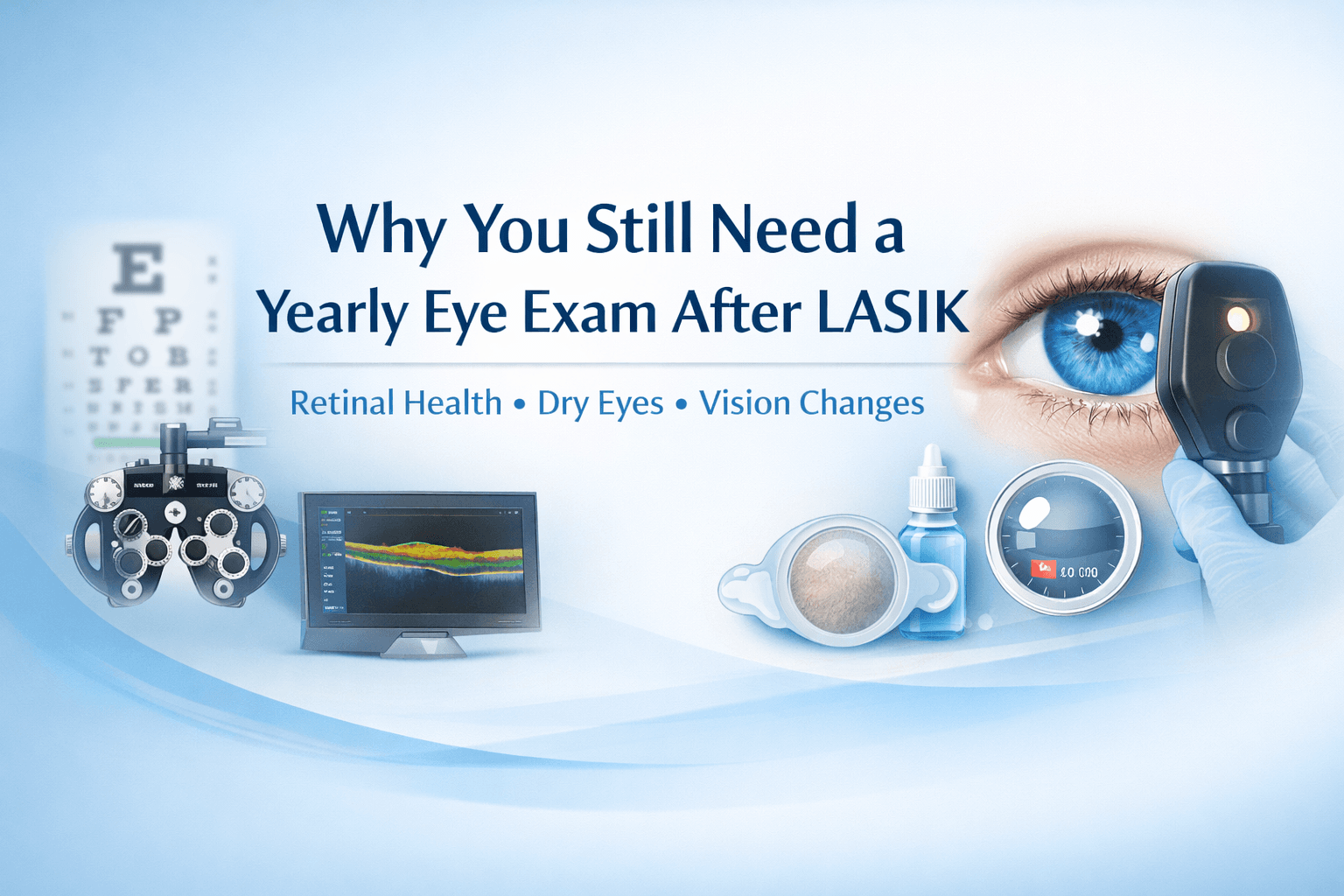
Why You Still Need a Yearly Eye Exam After LASIK
LASIK is highly effective at correcting myopia, hyperopia, and astigmatism. Many patients achieve 20/20 vision and assume they no longer need routine eye care.
However, LASIK reshapes the cornea — it does not prevent ocular disease.
Even with excellent uncorrected vision, annual comprehensive eye exams remain medically necessary.
LASIK Does Not Reduce Retinal or Glaucoma Risk
If you were myopic before LASIK, your retina is still anatomically myopic. Corneal refractive surgery does not change axial length or posterior segment risk.
Peer-reviewed data from 2025–2026 continue to confirm that individuals with prior high myopia remain at increased lifetime risk for:
- Retinal tears and retinal detachment
- Myopic maculopathy
- Primary open-angle glaucoma
Additionally, post-LASIK corneal thinning can artificially lower intraocular pressure readings, potentially masking glaucoma if not interpreted properly.
Annual dilated retinal examinations and optic nerve imaging allow early detection — often before symptoms occur.
Dry Eye Is More Common After LASIK
LASIK flap creation disrupts corneal nerves, affecting tear production and ocular surface stability. Although partial nerve regeneration occurs, recent prospective studies (2025) demonstrate persistent tear film instability and higher rates of chronic dry eye in post-LASIK patients.
Dry eye may cause:
- Fluctuating vision
- Glare or halos
- Ocular surface inflammation
- Contact lens intolerance if enhancement is needed
Routine exams allow objective tear film assessment and early treatment before symptoms become chronic.
Your Prescription Can Still Change
LASIK does not stop natural physiologic changes such as:
- Myopic regression
- Presbyopia
- Early cataract formation
Long-term outcome studies published in 2025 show measurable regression in a subset of patients, particularly those with higher pre-operative prescriptions.
An annual refraction ensures visual stability and helps differentiate regression from early lens changes.
The Bottom Line
LASIK improves refractive error.
It does not eliminate the risk of ocular disease.
A yearly comprehensive exam should still include:
- Dilated retinal evaluation
- Intraocular pressure measurement
- Optic nerve assessment
- Refraction
- Ocular surface evaluation
Clear vision is only one component of eye health. Ongoing monitoring protects long-term retinal and optic nerve function. Schedule your LASIK follow-up or post-LASIK annual exam with Dr. Latek today!
References
- Smith J et al. Long-Term Retinal Risk in High Myopia After Corneal Refractive Surgery. Ophthalmology. 2025.
- Chang R et al. Retinal Detachment Incidence in Post-LASIK Myopes: A 15-Year Cohort Analysis. Am J Ophthalmol. 2026.
- Lee H et al. Corneal Nerve Regeneration and Persistent Dry Eye Following LASIK. Cornea. 2025.
- Martinez P et al. Tear Film Dysfunction After Laser Refractive Surgery. Ocular Surface. 2026.
- Gupta N et al. Long-Term Refractive Stability Following LASIK. J Refract Surg. 2025.